


















Gruyere Recipe
-

Yield
8 Pounds
-

Aging Time
6+ Months
-

Skill Level
Advanced
-

Author
Jim Wallace


Gruyere Recipe Info
About Gruyere Cheese
Gruyere’s Alpine Origins
Traditional Cheese Making Process
The Savoie Connection
Ingredients
Total price for selected items: Total price:

Instructions
-

Heat & Acidify Milk
I usually begin this cheese with either 8 or 16 gallons of milk. The larger size making for a longer aging cheese.
The recipe below is for 8 gallons of milk.
Begin by warming the milk to 90°F. Once reached add either:
- 1/8 tsp TA060 Thermophilic and 1/32 tsp LH100culture or
- 1 packet of C201 Thermophilic culture
culture1/32 tsp
You will also add the 1/32 tsp Proprionic Shermanii at this time.
Let your milk ripen for 1 hour.
-


Coagulate with Rennet
Next add 1 tsp. (4.5ml) single strength liquid rennet, stir in gently and let sit quietly for 30 minutes to coagulate.
As the coagulation takes place you can check for a good set by using one of the methods shown above.
Note: You'll be looking for a soft curd set for this recipe. As the coagulation takes place you can now check for set a firm set by:
- A. Pull the curd back from the edge of the vat with the back of your hand.
- B. Press down on the curd to feel for a proper firmness.
- C. Use the traditional "splitting of the curd with a finger method."
-


Cut Curds & Release Whey
Before cutting the curd the cooler top layer should be turned over to warm for a few minutes.
The curd will be quite soft so first cut to 1 inch than let rest for minutes.
Next cut the curd to 1/4 inch and follow with a long stir to expel whey before the scalding.
-

Cook the Curds
After being cut, the curd is scalded to 114°F over the next 30 min.
Once the curd reaches it's scald temperature the stirring continues until proper dryness is reached.
More moisture for a younger, earlier ripening cheese and drier for a longer cave ageing.
Scalding the curds will will create the elastic texture and proper dryness as shown here
-


Drain the Curds
Now the whey should be drained down to the curd level. Once drained a weighted plate can be placed onto of the curds for pre-pressing which will consolidate the curd into a compact mass. For pre-pressing add 8-12 lbs of weight ontop of the plate.
-


Mold & Press Curds
Following the pre-press, the consolidated curd mass can now be gathered in a cloth and transferred to the waiting form.
Up until this point, very little acidity has been produced by the cultures due to the high temps so far.
From this point on the Thermophilic culture will become active as the cheese cools down and the pH will begin to drop as lactose is converted to lactic acid
For this cheese use 25 lbs of weight and work up to a final weight of 50-100 lbs depending on how long you plan to age the cheese. Less weight will yield a higher final moisture and hence young to medium aging cheese.
The total pressing time will be 18-24 hours. The goal is to end up with a cheese that is quite dry yet elastic to undergo many months of aging.
-

Salting
You will need a saturated brine prepared for salting this cheese, find all of the details you need on brining here.
A simple brine formula is:
- 1 gallon of water
- 2.25 lbs of salt
- 1 Tbs calcium chloride
- 1 tsp white vinegar
- Bring the brine and cheese to 50-55°F before using
Your cheese can now be removed from the mold and placed into a brine solution for 24 hours. Be sure to sprinkle the top of your cheese with some cheese salt, flip it half way through and sprinkle salt over the top once more.
Once your cheese has been brined place it into a cheese cave at 54°F and 85% RH.
For the next 2-3 days apply a rubbing with dry salt to the surface of your cheese.
-


Aging
The cheese is now ready to be aged for 30-40 days.
The aging temperature is 54-58°F and humidity of 85-87% should be maintained. Any surface mold should be wiped away with a saturated brine solution.
Once the rind forms the cheese should be kept quite moist and washed with a light brine solution 2-3 times a week for 8-14 months. This will help to develop the proper ripening surface.
After a few months you will start to notice a traditional damp rosy rind forming.
-

Finished Cheese
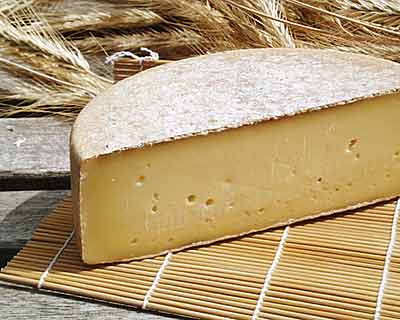
Finally, at 8-14 months the cheese will be ready. Note the smaller holes resulting from a cool cave temperature.
Cheese Making Supplies
Related Products
You May Also Like