







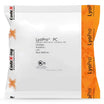
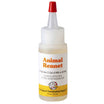






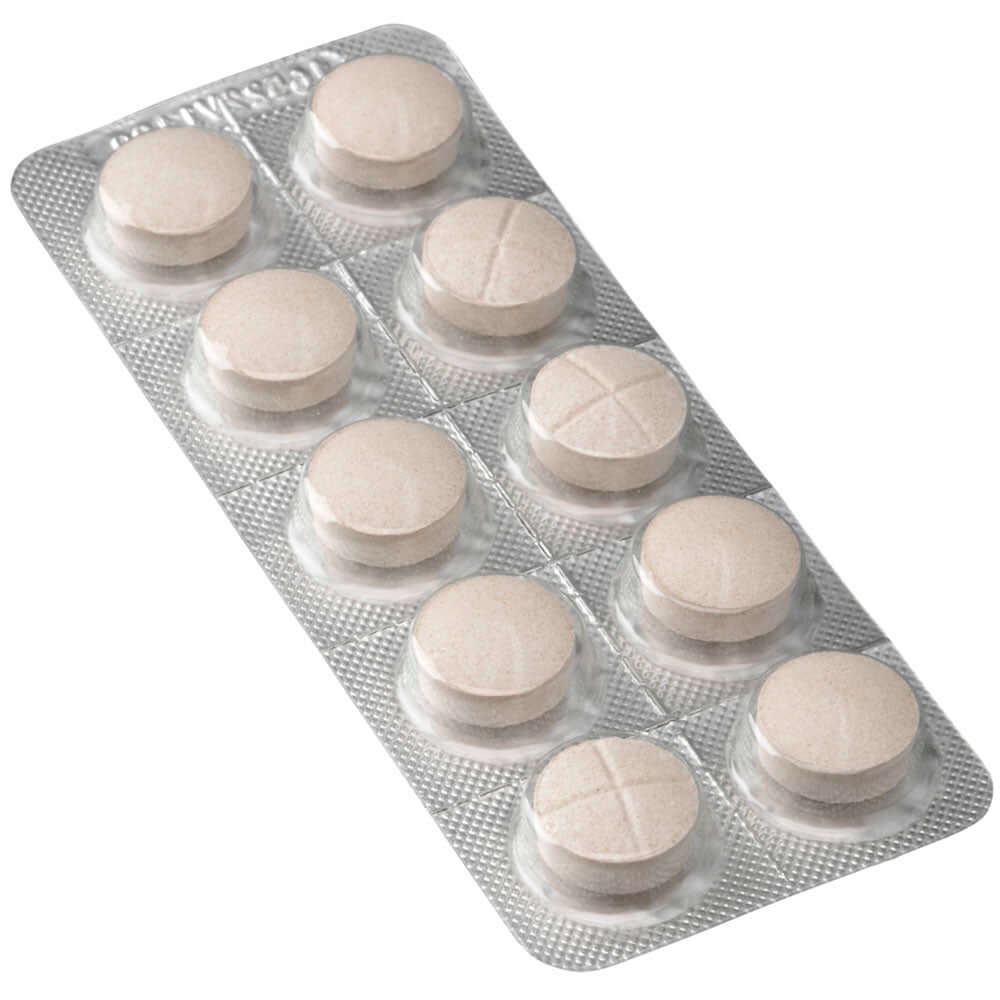
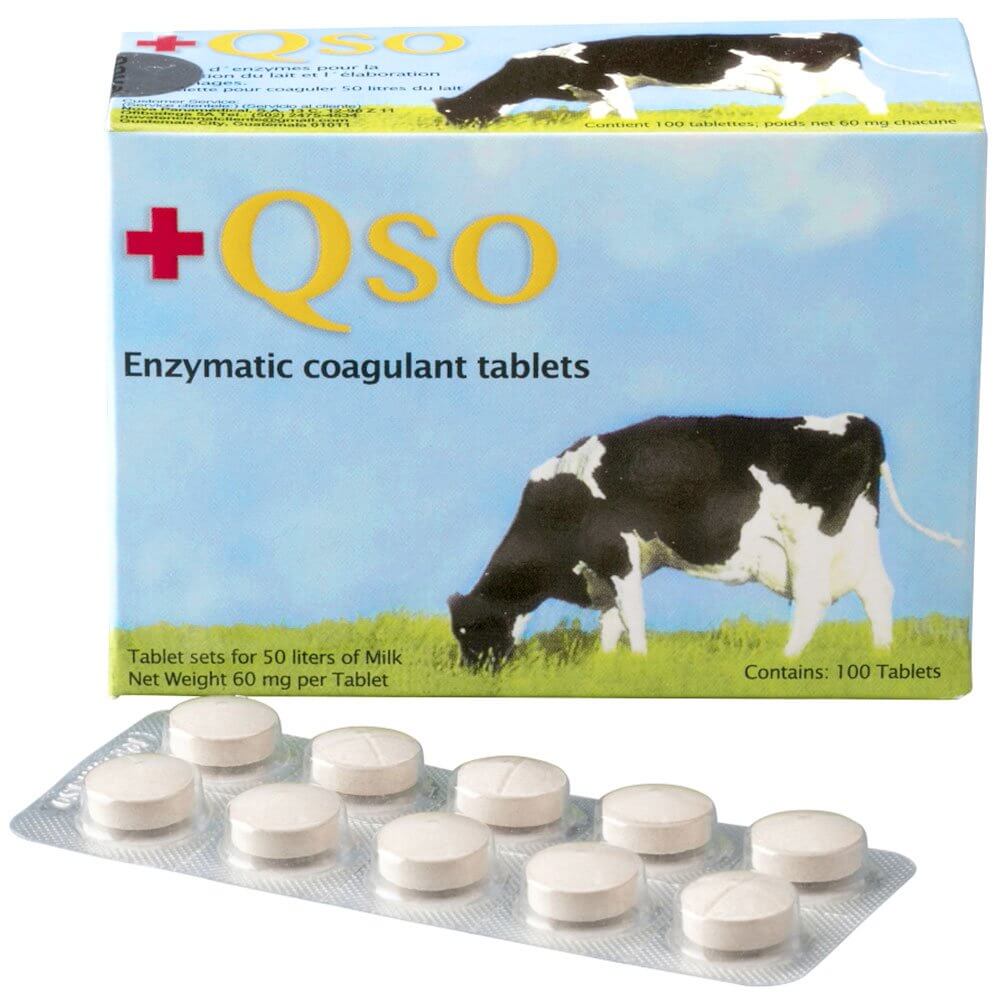
These tablets contain no animal products, are gluten free and Non-GMO. Each tablet is scored into 4 segements for ease of use.
INGREDIENTS: Microbial coagulant (Mucur Pussillus and/or Mucur Miehei), Megnesium Stearate, Microcrystaline Cellulose.
YIELD: 1/2 tablet will set 2 gallons of milk in approximately 45 minutes at 86-95F. Twenty tablets will set approximately 80 gallons of milk.
DIRECTIONS: Crush desired portion of tablet and dissolve in 1/4c. cool, non-chlorinated water. Add to milk when specified in recipe. Stir to distribute thoroughly. NEVER keep part of rennet solution for later use. When using store bought milk you may need to add a little more rennet.
STORAGE: Store rennet tablets in the freezer. They will last at least 3 years if stored properly.
RENNETTING
General Questions
After
the milk has been acidified, rennet is added. This causes the proteins
in the milk to form a curd and allows the liquid to separate and run off
as whey. The amount of rennet used in the different cheeses varies
because of specific cheese requirements. Some need a firmer curd than
others and some need a longer timeframe for coagulation. The curds for
each cheese are different.
1. What is rennet?
Traditional animal rennet is an enzyme derived from
the stomachs of calves, lambs or goats before they consume anything but
milk. (Ours is all from calves.) It is about 90% pure chymosin.
Vegetable
rennet is obtained from a type of mold (Mucur Miehei). However, even
though it is derived from mold, there is no mold contained in the final
product. It is an equivalent chymosin product which works equally well
but is not animal derived.
Rennet thrives at temperatures in the 85-105F
range, but it won't be deactivated completely until it reaches the
140F's. Rennet continues working to set the milk as long as it has the
right conditions. So, when a recipe calls for cutting the curds after a
certain time period, it is important to follow the directions.
Otherwise, your curds may be too firm for the cheese you are trying to
make.
2. How do I choose which rennet to use?
Rennet is standardized, so all the different kinds of
rennet (liquid, tablet or powder) work the same to set milk. Liquid is
the easiest to work with because you can measure it very precisely.
However, the powders and tablets will keep better under more adverse
conditions.
Calf rennet is considered to be the best choice
for longer aged cheeses because some of its residual components help to
complete the breakdown of proteins. Some of the more complex proteins
in the vegetable rennet can have a slightly bitter taste after 6 months
of aging.
The liquid vegetable rennet is Kosher, but it has been re-packaged without Kosher supervision.
3. How much salt is in rennet?
The amount of salt in rennet is miniscule. It is there
as a preservative. Considering that you add 1/4 teaspoon of rennet to a
gallon of milk and that much of the rennet runs off with the whey
during draining, the amount of salt left in the cheese is virtually
impossible to measure.
If you are interested in making cheese with no
salt, the fresh cheeses, Mozzarella and Ricotta are best suited for
this. The aged cheeses require a slight amount of salt to sow bacterial
activity.
4. Can I use junket tablets as a substitute for rennet?
No. Cheese rennet is 80% chymosin and 20% pepsin.
Junket is 80% pepsin, so it is much weaker than cheese rennet. Even if
you use more of it to compensate for this, there is so much pepsin in
junket that it increases protein breakdown to the point where there are
problems when the cheese ages.
Junket was made for custards. If you read the
label, you will see that there are many additives in it. In spite of
this, and despite the price of junket (not inexpensive), there are many
recipes online for making cheese with junket. We think this originated
when supplies were hard to find for home cheese making. Now that they
are widely available, there is less reason to use junket.
5. Can I make my own rennet?
Making calf rennet used to be handed down from
generation to generation. Cheese makers knew what to expect from this
process. Today, some folks do make their own rennet, but the problem is
figuring out how much to add to their cheese. It can take them many
years to standardize the process.
Some people also make their own vegetable rennet
from the juice of nettles, figs, etc. This seems to work for sheep's
milk and soft cheeses, but not for the aged, hard cheeses.
Note: If you make your own rennet, you will
not be able to sell your cheese in the US, because regulations stipulate
the use of prepared, standardized rennet.
6. How do I test my rennet to see if it has expired?
This is how we test our rennet: Heat one cup of
milk to 90F. (Do not add citric acid.) Dissolve 1/4 rennet tablet (or
1/4 tsp. liquid rennet) in 8 oz of cool water and stir well. From this
diluted rennet take 2 tablespoons and add it to the milk at 90F. Stir
gently from the bottom to the top for 30 seconds.
If the rennet is working, the milk surface will
begin to firm or form a slight film after two minutes. After six
minutes, it will have formed a curd that will hold a knife cut.
7. How long is my rennet good after I have diluted it in water?
You have 1/2 hour until it begins to lose effectiveness.

8. Are any of your rennets genetically modified (GMO)?
No. We have taken a strong stand against genetic modification.
9. I am having trouble monitoring the temperature of the milk after I add the rennet.
This should not be an issue, because after adding
rennet, you should not be adding any more heat (there may be a few
degrees of upward heat increase). Once the curds are cut, you can begin
to heat while stirring very slowly. At this point, the heat will
gradually transfer from the whey to the curd. (We recommend stopping the
heat a degree or two before reaching the final temperature.) If you
heat too rapidly, there will be a big difference between the whey and
curd temperatures.
Liquid Rennet
1. How long will liquid rennet keep in the refrigerator?
Liquid
rennet needs to be stored in the refrigerator. Animal rennet will last
up to one year, vegetable rennet will last 4-6 months, organic vegetable
rennet will last 3-4 months. After the suggest shelf life the strength
will gradually drop.
2. Do I have to dilute it?
Liquid rennet should always be diluted in non-chlorinated water before adding to your milk.
The liquid vegetable rennet is double-strength, so you will always need to use half as much as the recipe calls for.
Rennet Tablets
1. How long will the tablets keep?
Our vegetable rennet tablets will last for at least 5 years, if kept frozen. If they are not refrigerated, they will last at least one year.
2. How do I cut the tablets?
To cut the tablets, you may use a pill cutter. Or, a
quick rap on the back of a sharp knife placed on the score marks will
usually work.
3. How do I convert the liquid amount to the tablet amount?
The conversion is 1/4 teaspoon liquid rennet = 1/4 vegetable rennet tablet.
4. If my recipe calls for 1/8 tsp. or a few drops of liquid rennet, how do I use my tablets?
If your recipe calls for 1/8 tsp. liquid, cut off 1/4
tablet, dissolve it in 1/2 cup of non-chlorinated water, and then, throw
away half of it.
If your recipe calls for only a few drops of
liquid rennet, it will be hard to convert this to the tablets. The
tablets are very difficult to measure in small amounts like this. (This
is why we include rennet in the soft cheese cultures.) If you will be
adding tiny amounts of rennet, it is more convenient to use the liquid
rennet.
Powdered Rennet
1. How do I decide whether to use powdered rennet or one of the other kinds?
We recommend using the powder when making larger
quantities of cheese. For one or two gallon batches, the liquids or
tablets are much easier to measure.
2. How do I store it?
Store in a cool, dry place, away from direct light. The ideal storage temperature is 38 to 45F. Containers should be kept c
losed.
3. Has this product been genetically modified?
No. None of our rennets have been genetically modified. However, most commercial powdered rennets are GMO.
4. How much powder do I use?
1/3 gram (approx. 1/16 tsp) will set 2 gallons
of milk for a 'normal curd.' (It is a small amount because this rennet
is very concentrated.) Adjustments should be made for softer or firmer
curds. Under ideal storage, the preparation displays excellent long term
stability (less than 5% activity loss in 12 months).
Note: There is no storage potential after hydration. It must be used immediately.