








Search Our Site:


Join Our Free Monthly Moosletter

For Email Newsletters
you can trust

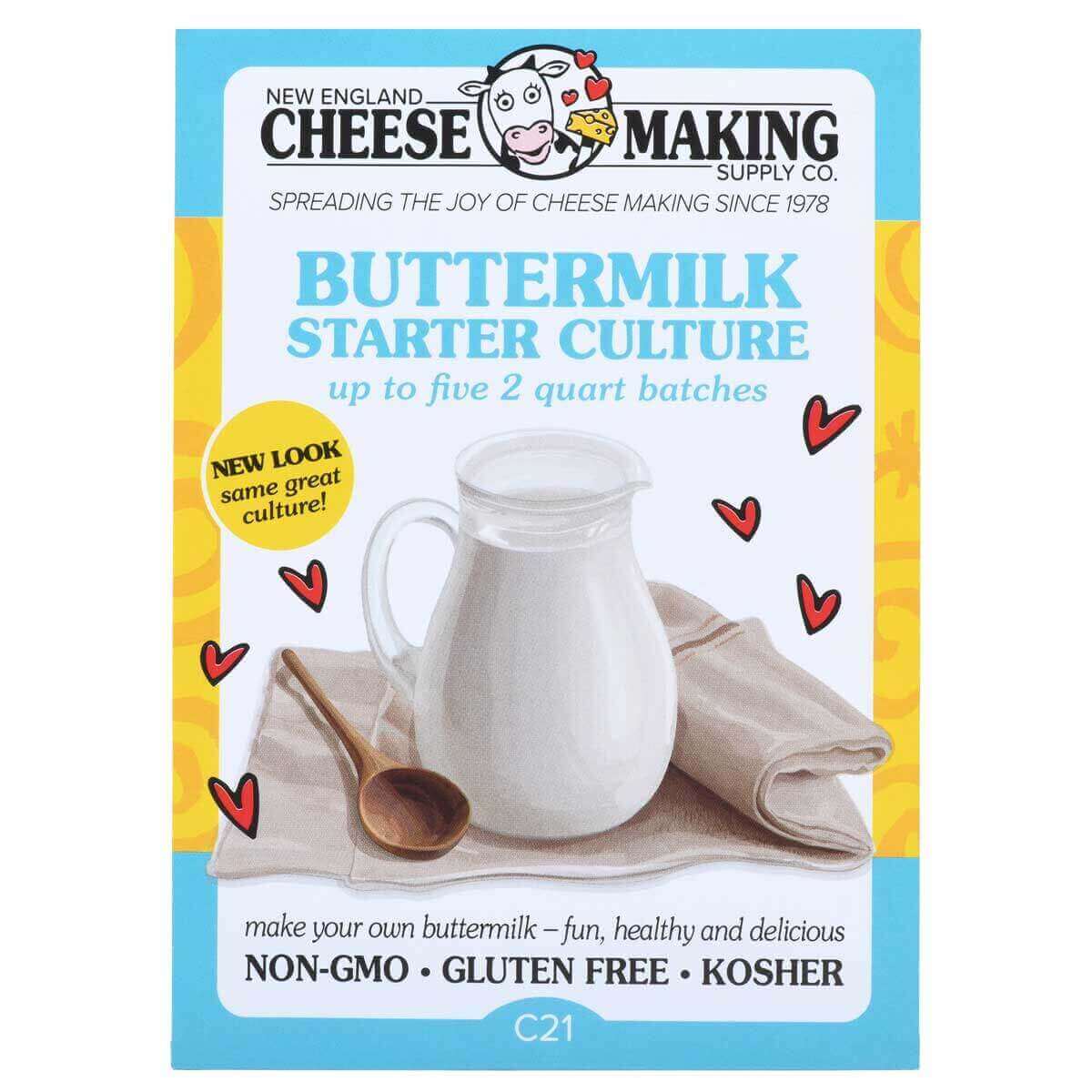
Buttermilk (DS) - 5 packets

Item #:C21 

   Our Price:$5.95
Quantity
Availability: In Stock
Usually ships In 2-3 Business Days


Share

This is a thick, old-fashioned New England Buttermilk which can be made with skim or whole milk.
The amount of character (acid, flavor, texture) can be controlled by increasing or decreasing time and/or temperature.

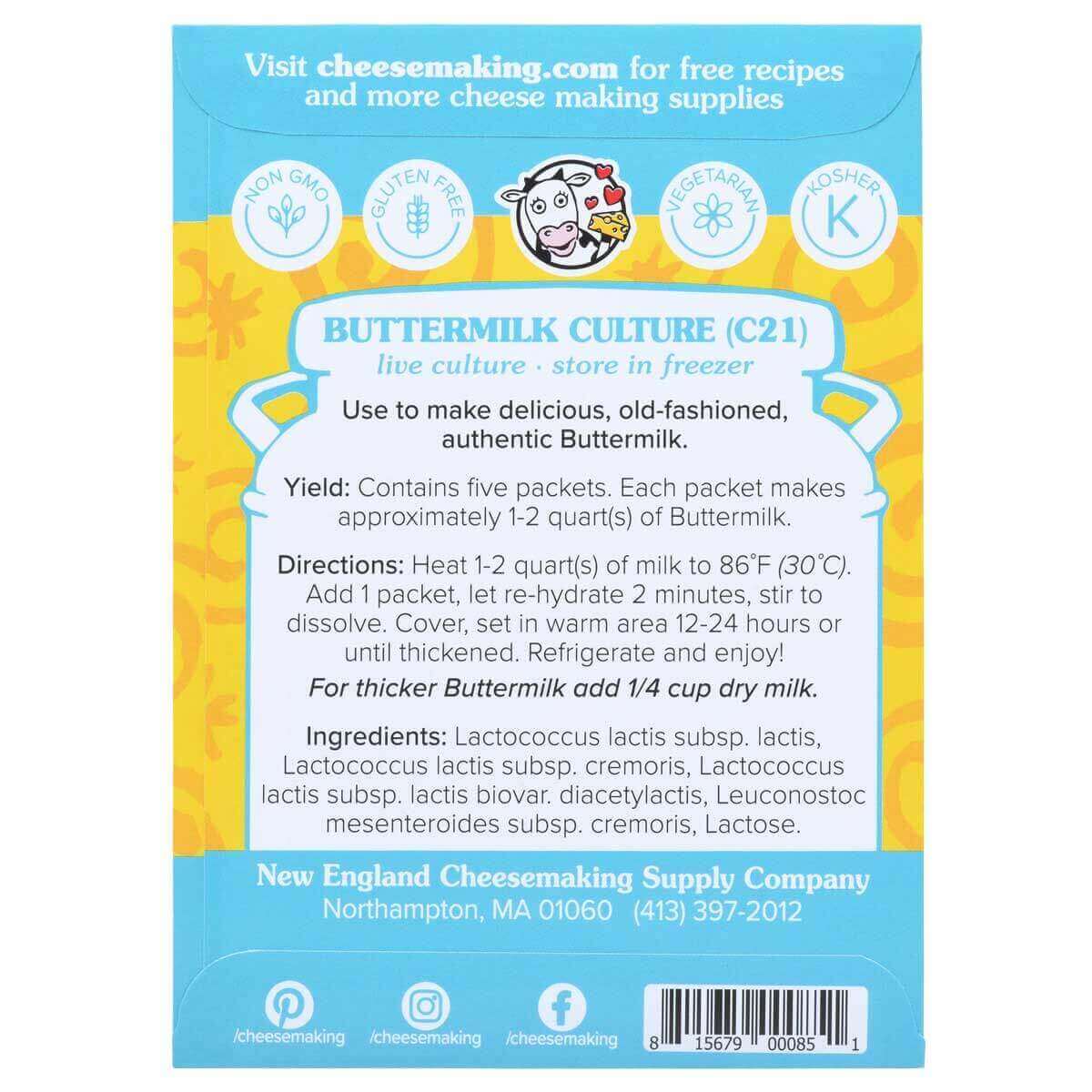
CULTURE INCLUDES: lactose, (LL) lactococcus lactis subsp. lactis, (LLC) lactococcus lactis subsp. cremoris, (LLD) lactococcus lactis subsp. biovar diacetylactis, (LMC) leuconostoc mesenteroides subsp. cremoris.

YIELD: Each packet sets 1-2 quarts of milk and makes 1-2 quarts of buttermilk. We recommend using 1qt. If you would like to use 2qts. simply give it a little more time to set.

DIRECTIONS: At 72ºF sprinkle 1 packet onto your milk and let it rehydrate for 1-3 minutes. Then stir in to dissolve and let set 12 to 24 hours.

STORAGE: Keep packages in the freezer, they will last up to 2 years.

DISCOUNTS: If you really love these you can buy 12 or more (5 packs) and you will receive our price break of $3.00 for each 5 pack.

NOTE: Using our Yogotherm (E69) is a great way to incubate this culture. Your buttermilk will be thicker after it has cooled down. You may also use this culture in butter making.

Make a Cream Cheese
Better than you can buy !

The recipe for this month will be another simple cheese to make in the kitchen. However, when I began researching this one in more detail I found a lot about this cheese that I did not know before.


Cream cheese is similar to Neufchatel from France except that cream cheese has more butterfat - starting with a fat enriched milk of about 7-10%. When this has ripened and the whey drained, the final cheese will have a much higher butterfat content, depending on its final moisture.

Cream cheese also has a fresh acidity, due to the dairy bacteria converting lactose to lactic acid. This helps to balance the rich flavors from the cream.

However, if you are looking for a lighter cheese then you can easily make a leaner cheese by using less cream or a lower butterfat % cream (see my cream content chart here).  

Lowering the fat content of the cream too much tends increasingly to cause grainy texture and crumbly body, while increasing the fat content excessively tends to cause excessive smoothness and stickiness.

Cream cheese was originally produced in the US in New York State during the late 1800’s. It originally acquired its association with “Philadelphia,” not because it was made there but because at that time “Phillie” was known as the home of top quality food.

In the commercial process, because cream cheese has a higher fat content than other cheeses, and fat repels water, which tends to separate from the cheese, stabilizers such as guar, xanthan gum, and carob gums are added to prolong its shelf life. The commercial version tends to be essentially an industrial concoction of milk, enough cream to claim it's there and all sorts of gums and stabilizers to make it appear like what it isn't.

Here is an ingredient list from the industry standard Philadelphia Brand Cream Cheese: Pasteurized Nonfat Milk, and Milkfat, Cheese Culture, Salt, Stabilizers (Xanthan Gum, and/or Carob Bean Gum, and/or Guar Gum).

It is also cooked to much higher temperatures commercially to speed the process up. This is good for the producer's cash flow but not so good for the final product.

Because we try to keep these additions from our food sources here, our process will not include anything but great milk and cream, a traditional dairy culture and a few drops of rennet.

You will also find in the process instructions a rough guide for ripening and draining time, but more importantly, I have provided descriptions and visual cues to:

  1. Accommodate the differences in milk quality as well as milk/cream content.
  2. Allow you to produce exactly the style of cream cheese you want

A recipe for making your own cream cheese .....

...In the style that best suits your taste.

Before you begin:

You will need:

  • 1 gallon of whole milk (3.25%).  Make sure this is not ultra-pasturized, but homogenized is OK.
  • Plus 1 pint of heavy cream (36-40%)
  • Calcium chloride can be added for pasteurized cold stored milk and will help to form a firmer curd, using about 1/8-1/4 tsp per gallon of milk.
  • 1 packet of Ricki's Buttermilk culture, 1/8 tsp. of MM100 culture, or the same of Flora Danica
  • Liquid rennet (4-8 drops either animal or vegetable)
  • Salt - about 1 teaspoon (more can be added to suit your taste)
  • Herbs, etc. (optional and to your taste)
  • A large pot to hold 1.5-2 gallons of milk/cream
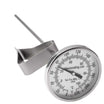
  • A good thermometer
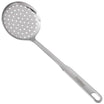
  • A knife to cut the curds, and a spoon or ladle to stir the curds
  • Molds
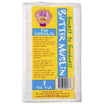
  • A colander and butter muslin to drain the curds

Note: You can cut this recipe in half by using 1/2 of all ingredients.

Everything needs to be clean and sanitized.

About the milk:

The milk I have chosen to use here is a local milk, but it is also one of the milks that has been pasteurized at higher than normal temperatures (172F as opposed to 161F).

I have selected this to use here because this is a milk that is becoming more and more common on store shelves.

As you will see in the following photos this does form a very wonderful cream cheese with super flavor and texture.

The cream is ultra-pasteurized, as you can see by the label here. This is not a problem, though, because the cream portion is just for the butterfat.
The milk portion will provide the proteins for curd formation and should not be ultra-pasteurized.

Some of our customers have tried using just half and half for their cream cheese but this often tends to be ultra-pasteurized and will not form a good solid curd since all of the proteins have been damaged in the process. If you do find half and half that is not ultra-pasteurized, that will work for a very rich cheese since it has a higher fat content than the recipe I provide. This may also be more difficult to drain since the butterfat holds the moisture.

NOTE:
If you do have access to raw milk, you will find that you may need to use less culture and that your ripening times are less. Your curd may also be firmer and you may find that the cheese drains faster. If you pay attention to the ripening and draining cues in the following process, you should be well on track to making a great cheese from your raw milk.

If you care to make up a different milk/fat ratio, this table may help

Cream % Content in Dairy Products
Heavy Whipping Cream
36-40%
Light Whipping Cream
30-36%
Light or Coffee Cream
18-30%
Single Cream 
20%
Half and Half
10.5% (10-18%)
Sour Cream
18-20%
Whole Pasteurized milk
3.25%

Getting started:

Pour the milk into your pot and slowly heat to 86F. Many recipes for this cheese suggest starting at room temperature, but the culture works best at 86F and I prefer to start it there. Happy culture always makes a better cheese. It is OK to allow the temperature to drop to room temperature over time.

  • Add 1/4 tsp calcium chloride solution and stir into the milk.
  • Add 1 packet of buttermilk culture (or 1/8 tsp of our MM100 culture). Allow this to rehydrate on the surface before stirring into the milk (keeps it from clumping).  Note:  Our C101 or MA011 cultures will not provide the added flavor from their ripening strains nor the lighter texture.
  • Add 4 drops of single strength rennet (animal or vegetable).

Initial ripening:

Cover the pot and set aside for ripening. The milk now needs to sit quiet for 12-24 hours while the culture works and the rennet coagulates the curd. It is OK if the temperature drops to a temperature of 68-72F. The thermal mass of this milk should keep it warm for a while though.

This is where your natural flavor is developed from the complex strains of lactic bacteria as they convert the milk sugars (lactose) to lactic acid. These cultures will produce a buttery flavored compound (Diacetyl) which is a natural byproduct of fermentation. Also a small amount of tiny gas holes (CO2) will be formed causing a lighter texture in the final cheese.
Note- Our C101 or MA011 cultures will not provide the added flavor from their ripening strains nor the lighter texture.

The higher process temperatures and thickener additions of commercial producers are needed for their shorter process and do not allow the use of this longer beneficial ripening time (this is the flavor development time).

Ripening may take 12-24 hours depending on the milk quality and room temperature. My conditions here show this ripening phase in about 14-16 hours but you should watch for the proper ripening of your own milk. I encourage you to watch for this final ripening phase as described below.

This final ripening can be determined visually because when the proper amount of acid has been produced, you will notice first small droplets of whey forming on the surface, then these will collect as small pools and then finally a thin layer of whey will cover the entire surface.

I usually determine the readiness by watching for small pools about 2-3” in size. You may also see the curd mass pull slightly away from the sides of the pot.

If you have a pH meter, the proper ripe state will measure about 5.1-4.9 pH or a titrateable acidity of .5% but there is no need to get that technical here.

Too long a ripening may result in an over acid cheese. 

Some acid production will continue during the draining stage so expect a bit more acid flavor while the whey drains off.

Too short a time may result in a weak curd that may be hard to drain and may even run off through the cloth. Make sure the curd holds a good clean break when cut before transferring to the cloth for draining.

Now for the draining:

Once the final ripening of the milk has been reached, the curd mass should now be firm enough to be transferred with a slotted spoon to the draining cloth. 

Prepare a sanitized colander. You need either 1 large or 2 medium sized since this will be a lot of curd to be drained. Line this with a double layer of the butter muslin. Make sure you have a container to collect the whey in. This can be used for cooking, drinking, etc. but not for making ricotta due to high acid.

Transfer the curd to the cloth for draining (be careful since this is quite fragile at this point and may break)


Allow this to drain for 1-2 hours to release much of the whey- then pull all 4 corners of the cloth up and tie off with a string. Hang this in an area 68-74F to drain into a pot or sink for another 10-20 hours.

During the draining time you should open the cloth every 3-4 hours and scrape the curd from the cloth- mixing the curds to encourage better whey drainage. If your schedule does not permit this it may just take longer to drain.
Also, at the last mixing of the curds 1 tsp. salt can be added for flavor and to encourage the final whey release.

The final draining time will depend on your preference for texture. The longer it drains, the drier and stiffer (less spreadable) the final cheese. I drain mine here about 16-20 hours for a nice firm cream cheese but still quite spreadable.

If you find your cream cheese with too much moisture, then simply drain it a bit longer next time. Remember that warmer draining temperatures will drain moisture more quickly. Also, the rate of draining will depend on different milk qualities and higher fat milks will drain more slowly.

Finishing the cream cheese:

When the cheese has reached its final consistency, you can then use a spoon to blend it well in a bowl for a more homogenous cheese. This would be the time to add any herbs, spices, etc. and to adjust the salt to your taste. You may even use fresh herbs in this because it should all be eaten fresh within a few days.

I transfer mine to small clean and sanitized plastic tubs with lids and store at fridge temps. Freshness is never a problem here because it's gone in just a few days. You should easily get 8-10 days or even more of storage for this cheese.


My yield is normally about 1.5-2 pints of cream cheese from the original 5 pints of milk/cream.

 Tips:

  • If your curd is too soft at the end of the initial ripening time, wait a few more hours (up to another 4-6 hrs). If this does not help, try keeping the milk 3-5F warmer on the next try. Also, you can increase the rennet up to double the recommendation.
  • If your final cheese is too acid, then use less time in the initial ripening phase OR use a bit less culture.
  • If your final cheese is too dry, use less draining time in the cloth. If too moist use more.

That's it for this month. Enjoy your new adventure in cheese making.

Yes 

No 

Allergens 

Description of Components 


 X Wheat  
   X Other Cereals containing gluten  
   X Crustaceans   
   X Eggs  
   X Fish  
   X Peanuts   
   X

Soybeans

 
 X   Milk (including lactose)
   X Nuts  
   X Celery  
   X Mustard  
   X Sesame Seeds  
   X Sulphur Dioxide & Sulphits (> 10 mg/kg)  
   X Lupin  
   X Molluscs  


Product Reviews
Overall Customer Rating:
Customer Reviews: 2
I love this this starter!
Rating:
Author:
Elena
Location:
Israel

Pros:
Cons:
I make my own buttermilk from 3% cow milk UHP- this starter works slowly, but gives a wonderful thick tangy cultured milk product! I add ussually(for 1 lt of milk ) - 2 tbsp of dry low-fat milk, 1 tsp of inulin, and in last batch i added 2 tsp of honey (something 30 minuts before thickening - when milk is still liquid). Thank you!
Using Buttermilk-DS as a mesophilic starter
Rating:
Author:
Robert Goff
Location:
Blacksburg, VA

Pros:
  • good buttermilk
  • good buttermilk cheese
  • good farmhouse cheddar
  • good Swiss-style cream cheese
Cons:
  • none
This starter, of course, makes wonderful cultered buttermilk and a tangy buttermilk soft cheese, as instructed in Ricki's book. Out of curiosity, I tried the Buttermilk-DS starter in in a farmhouse CHEDDAR recipe. It produced a good, firm curd (with a subtle buttery aroma), and produced a lovely, solid wheel after pressing up to 50 pounds. The cheese, after 6 weeks of aging in wax at 48 degrees, resembles gouda with a bit more acid tang. Very nice. One further experiment was to use it in Ricki's recipe for Swiss-style CREAM CHEESE. For this, I deviated from the her published recipe by using 1 packet of Buttermilk-DS in 2 quarts (rather than 1 quart) of Kroger brand Half and Half (the 1 quart Kroger Half and Half is not UP, although their similar label 1/2 gallon IS UP!), and performed all the lengthy setting and draining at 63 degrees F (the winter temp of my kitchen) rather than her suggested 65 degrees. Press weight was 10 pounds. WOW! Whereas the predicted yield was about 1 pound, I ended up with 2 pounds of the richest, creamy and full-flavored cream cheese I've ever tasted. I suspect that the Leuconostoc mesenteroides subspecies cremoris that appears to be contained in the Buttermilk-DS came into its own at the lower temperature. One could imagine that this particular bug lurks in the raw milk of the Alps. My point in writing this review is to encourage others to consider the Buttermilk-DS starter as an interesting variant for any recipies that call for a simple direct-set mesophilic starter. [As a probiotic, the s. cremoris appears from the scientific literature to be more potent than the various probiotic bugs found in yogurts.]

I was given some of this culture from the Flack Family Farm in Vermont--it is awesome! I ran out and Doug Flack gave me your website. Thanks for an amazing product. 
I ordered and recieved my cultures including the one for Buttermilk. I made the first QT according to directions by pasturizing my Goat milk. Delicious! Since then I have made two more batches with RAW milk and used one packet to a half Gallon. This is also just GREAT! Thanks for the wonderful culture! 
I was given some C21 Buttermilk culture from a friend, sure did make good butermilk. Thank you, Mary Harvey, VA 

You might also like...
Sour Cream (DS) - 5 packets

Price:$5.95

Qty:
Fromage Blanc(DS)-5 pack

Price:$5.95

Qty:
Mesophilic(DS) - 5pack

Price:$5.95

Qty:

Featured Items


What are people saying about us? Check it out here.


The Cheese Queen is in Food and Wine and Barbara Kingsolver's
book Animal, Vegetable, Miracle!

Thanks for joining our cheese making family, keep those stories & photos coming. We love to hear from you!

In Peace,
Ricki, the cheese queen

SHARE THIS PAGE

  SecurityMetrics for PCI Compliance, QSA, IDS, Penetration Testing, Forensics, and Vulnerability Assessment

©2011 New England Cheesemaking Supply, Inc. All Rights Reserved

New England Cheesemaking Supply Company
54B Whately Rd, South Deerfield, MA 01373
E-mail info@cheesemaking.com

Phone (413) 397-2012  Fax (413) 397-2014
Store Hours: Monday-Friday 9am-4pm EST
We are out for lunch from 12:00pm-12:30pm EST


Click here for our Return/Exchange Form