
















|
|
Join Our Free Monthly Moosletter
 |
|
|
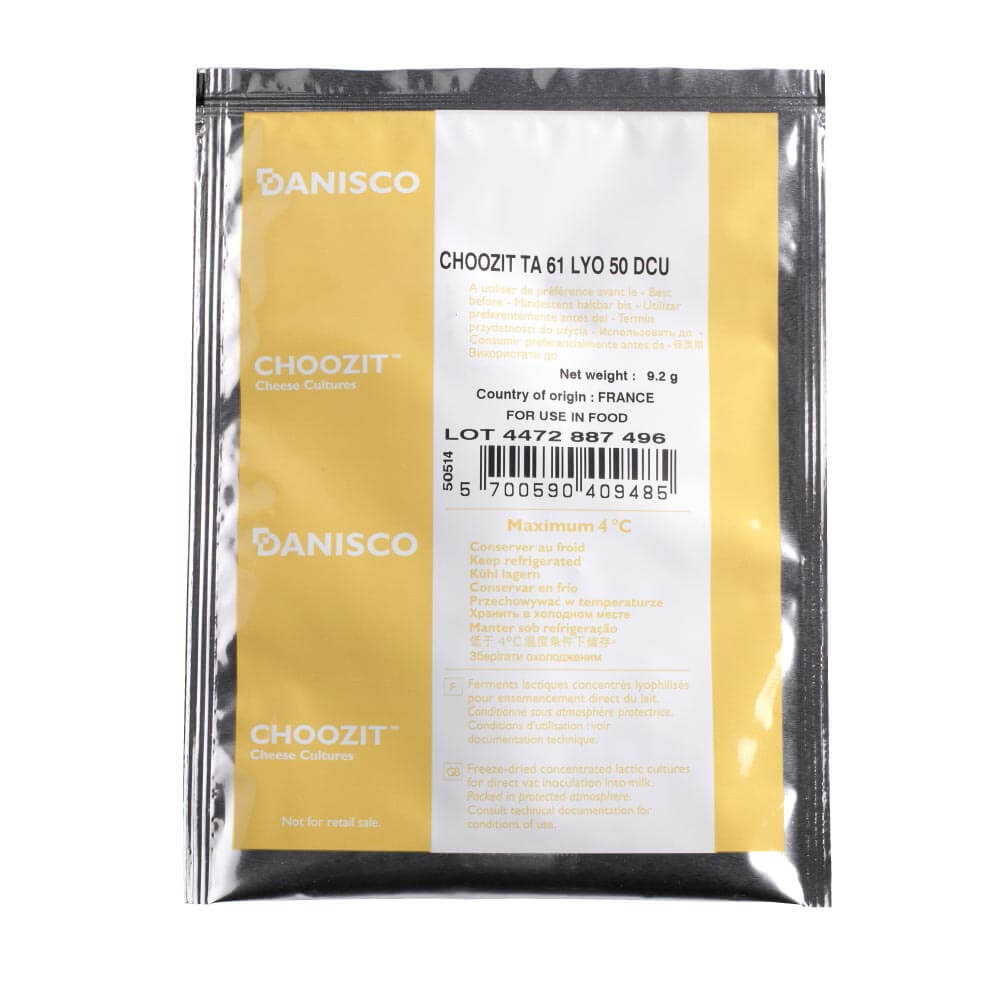
Thermophilic- Large Pack
Item #:TA 061 |
|
|
|
|
Share
A Thermophilic acid producing culture for typical hard, Italian & Swiss cheeses such as Parmesan, Romano, Mozzarella, Provolone, Emmenthaler/Swiss.Effective Temperature range is 68°- 125°F with an Optimum growth of 104°-108°F. Many cheeses of this style are heated to very high temperatures(122°-128°F) and even though there is little to no acid produced in this range, they will survive quite well. As soon as the temperature of the cooling cheese falls into the optimum range they will begin their acid production. CULTURE CONTAINS: Streptococcus thermophilus YIELD: Will set up to 250 gallons of milk. Can be divided into 25 gallon batches for farmstead use and 8-10 gallon batches for home use. DIRECTIONS: 1/2 teaspoon will set approximately 6-12 gallons. When using raw milk, reduce amount of culture used by 25-50%. This is to be used as a guide since setting temperature, stage of milk and type of cheese will call for specific amounts to reach proper acidification rate. STORAGE: Store in the freezer. Culture will last up to one year if stored properly. NOTE: This product is Certified Kosher OU. CLICK HERE to view a copy of the kosher certification of this product.
CHOOZIT Culture
Packs
|
|
What are they and how will
they affect the cheese we make ??
These larger packs of culture offer a greater choice in cultures but are
intended for larger cheese batches. Guidelines suggest that they are quantities
for much larger vat batches but we find that they can be divided easily for 25
Gal farmstead or even 8-10 Gal home cheese maker batches.
| MA011 |
• |
This is the mesophilic culture to use when you want
a clean cheese flavor and a very close curd
texture.
These mesophilic cultures will provide the
essential acidity without gas production sometimes referred to as
homofermentive.
Ideal for semi-soft and fresh cheeses such
as: Cheddar, Colby, Monterrey Jack, Feta, Chevre,
etc.
Contains: Lactococcus lactis subsp.
lactis Lactococcus lactis subsp. cremoris
These are two primary lactic
acid producing bacteria used for cheese making They are Homofermentive
bacteria, primarily used for producing lactic acid. Temp growth range is 10°
- 42°C (50°- 102° F.) with an Optimum growth rate = 25° - 30°C (77°- 88°
F.) Cremoris is more salt sensitive [<4%] and more temperature sensitive
[<40°C/102°F]
|
| MA4002 |
• |
This is a great choice for any of the cheeses made
with MA011 but with the added thermophilis will aid in the ripening
process.
This is what is commonly referred to as the
'Farmstead culture.' It is predominantly a blend of standard mesophilic lactic
acid cultures similar to MA 011 to develop the primary acidity. It also contains
a S.thermophilis which will serve as a ripening culture a bit later in the
process. The Mesophilic cultures will produce the acidity during the first part
of the process.Then, after the cheese is salted and in the cave, the
Thermophilic cultures begin to work in a ripening capacity to break down the
complex proteins into simpler components.
Contains: Lactococcus lactis subsp.
lactis Lactococcus lactis subsp. cremoris Lactococcus lactis subsp.
diacetylactis Streptococcus thermophilus
|
| MM100 |
• |
This is the mesophilic culture to use for a more
pronounced butter like flavor and a somewhat more open
texture
Another Mesophilic culture for soft ripened, and
fresh cheeses such as: Brie, Camembert, Gouda, Edam, Blue, Feta, Havarti,
Chevre, etc.
This culture contains the 2 primary cultures of MA011 but
the diacetylactis will produce CO2 and a butter like flavor/aroma. Cheese made
with this culture will be somewhat more open in texture and in a cheese such as
gouda/edam will provide the typical small round
holes.
Contains: (LL) Lactococcus lactis
subsp. lactis (LLC) Lactococcus lactis subsp. cremoris (LLD) Lactococcus
lactis subsp. lactis biovar diacetylactis
|
| TA061 |
• |
This culture works quite well for high temp scalded
cheeses
A Thermophilic acid producing culture for typical
hard, Italian & Swiss cheeses such as Parmesan, Romano, Mozzarella,
Provolone,
Emmenthaler/Swiss.
Contains: Lactococcus
lactis subsp. lactis Lactococcus lactis subsp. cremoris Lactococcus lactis
subsp. diacetylactis Streptococcus thermophilus
Effective Temperature
range is 68°- 125°F with an Optimum growth of 104°-108°F Many cheeses of this
style are heated to very high temps(122°-128°F) and even though there is little
to no acid produced in this range they will survive quite well and as soon as
the temp of the cooling cheese falls into the optimum range they will begin
their acid production.
|
| LH100 |
• |
Used in combination with TA 061
culture for hard mountain style cheeses
Lactobacillus
Helveticus is used in conjunction with other thermophilic cultures (such as
TA061) in mountain style cheese such as: Emmenthaler and Gruyere
etc.
Contains: Lactococcus lactis subsp.
lactis Lactococcus lactis subsp. cremoris Lactococcus lactis subsp.
diacetylactis Streptococcus thermophilus
This culture will begin it's
role following pressing and cooling of the cheese and is a major factor in the
flavor of theses mountain style cheeses. It's primary role is ripening in the
breakdown of protein (Proteolysis) in the later stages of aging. This is of
central importance for the development of cheese body characteristics and the
formation of flavor.
|
| MD088 |
• |
This culture is usually used with other mesophilic
cultures to enhance flavor (buttery) and produce some small eyes in fresh and
soft ripened cheeses cheese such Edam or Havarti. We suggest
you use it as a flavor enhancer for your cheese.
Used in combination with
other mesophilic cultures this culture is a very slow acid producer and is
usually not used by itself but in combination with other mesophilic cultures
such as MA 011. This culture is used to enhance flavor (buttery) and produce
some small eyes in cheese such Edam or Havarti. Suggest use as a flavor enhancer
for your cheese. It is often used to provide more openness in Blue cheese due
to it's gas
production.
Contains: Lactococcus lactis
subsp. biovar diacetylactis
Using this in conjunction with MA 011 it will
be similar to MM 100 but you will be able to control the flavor and gas
producing aspects to your satisfaction by increasing or decreasing the amount of
MD 088 used
|
How should we use
them??
The key here is that a single culture pack will set
many gallons of milk. So our task is to figure out how to section out just
enough culture for the quantity of milk we are using and to get the right amount
of activity for the cheese we plan to make.
We offer 2 methods: |
| Quick and Easy |
• |
each pack can be divided up so that 1/2 tsp will
inoculate about 6-12 Gal of milk. If using raw milk that can
be reduced by 25-50%. We do encourage everyone to use this only as a guide
since setting temp, stage of milk, and type of cheese being made will call for
specific amounts of culture to reach the proper acidification
rate. |
| Precise Method |
• |
An accurate scale is needed for this... The packs come marked in
' Units' of 10, 20, or 50 We find that utilization of 1-2
Units will set 10 Gallons of milk, depending on milk and activity of starter
desired.
So, how do we measure what we need?
The standard rate of recomended use is 2 units
per 26.4 Gallons of milk or 1 Unit per 13.2 Gallons.
Since my last 20 Unit Pack of MA011 (less weight of package)
was equal to 17.7 grams then 1 Unit was equal to .89 grams
[17.7/20]
Now I have determined that my rate of Utilization
is a bit less at 1 Unit per 10 Gallons and have
18 gallons of milk to set. Therefore, I can calculate my
culture needed as :
.89 (weight of 1 U culture) x 18/10 = .89 x 1.8 = 1.6 grams of MA011
will set my 18 gallons of milk in the time I want
Please do your own tests to find the utilization rate that works for your
milk . |
|
| |
|
X |
Wheat |
|
| |
X |
Other Cereals containing gluten |
|
| |
X |
Crustaceans |
|
| |
X |
Eggs |
|
| |
X |
Fish |
|
| |
X |
Peanuts |
|
| |
X |
Soybeans |
|
| |
X |
Milk (including lactose) |
|
| |
X |
Nuts |
|
| |
X |
Celery |
|
| |
X |
Mustard |
|
| |
X |
Sesame Seeds |
|
| |
X |
Sulphur Dioxide & Sulphits (> 10 mg/kg) |
|
| |
X |
Lupin |
|
| |
X |
Molluscs |
|
|
|
What are people saying about us? Check it out here.

The Cheese Queen is in Food and Wine and Barbara Kingsolver's book Animal, Vegetable, Miracle!
Thanks for joining our cheese making family, keep those stories & photos coming. We love to hear from you!
In Peace, Ricki, the cheese queen | |