







Search Our Site:


Join Our Free Monthly Moosletter

For Email Newsletters
you can trust

Cheese Press - with 5 FREE Cultures (C1,C101,C2,C201,C21)

Item #:E28 

   Our Price:$279.95
Quantity
Availability: In Stock
Usually ships In 2-3 Business Days


Share

We proudly make these in the USA!!

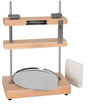
This press is handcrafted to last a lifetime. With this press you can easily press a variety of delicious hard cheeses including, but not limited to, Cheddar, Gouda, Parmesan and Monterey Jack.

DESCRIPTION: The stainless steel mold and drip tray sit on a hard wood base with rubber feet to protect your kitchen counter. Pressure is regulated with a stainless steel gauge measuring from 0 to 80 lbs. Easy to use, this press makes a great addition to your cheese making kitchen. Comes assembled and ready to use.

PRESS INCLUDES: 1-Stainless Steel Mold (2-4lb cheese), 2-Polypropylene Followers, 1-Stainless Steel Pressure Gauge, 1-Stainless Steel Separating Disc, 1-Stainless Steel Drip Tray, 2-Press Locks and A BONUS of 5 FREE Cultures - C1, C101, C2, C201C21 (a $29.95 value)

RETURN INFORMATION: This item is warrantied for 1 year from date of purchase against manufacturing defects. We do not accept returns of any used equipment. For our full return policy, please click here.

Proper Press Weights

The proper amount of weight for pressing a cheese should be to initially follow the cheese making guidelines for the particular cheese. However this can sometimes lead to over or under pressing the cheese due to the final cheese moisture or fat content.
  • Over pressing can be recognized by excessive cloudy/milky whey or even butterfat leaking with the draining whey or on the cheese surface when turning. The higher fat cheese also requires less weight in the early pressing stages when butterfat is still in a liquid state.
  • Under pressing is the cause of unconsolidated curds in the final cheese. This can be identified with open curd spaces on the rind or excessive open spaces in the cheese body.
  • A tight smooth rind with open spaces in the cheese body. Can be an indication of excessive press weight initially sealing the surface and trapping moisture inside. This is usually accompanied by a cheese leaking moisture in the aging room.

When unpacking the press, the scale may not read '0' 

This may be the result of spring compression during shipping. Simply release and remove the locking blocks and allow the springs to decompress. Do not store the press with springs compressed. There is also a small amount of movement in the scale strip and this can be adjusted slightly to the '0' mark by loosening the screw adjusting the strip and re-tightening the screw. Our springs and scale strips are designed to work together for the proper press weight.

Pressing


C:\Users\jeri\Desktop\cheese pictures\bigstockphoto_Cheese_Press_575318.jpg

1. Why do we use cheesecloth when we are pressing the cheese?

Cheesecloth is essential in molding. Its purpose is to wick the moisture from the surface of the cheese to the drainage holes during pressing.

2. Why am I supposed to start with less weight and then add as I go?

The low press weight to start with begins to consolidate the curd and will not block the whey release. By the time you add the highest weight, most of the whey has been pressed out.

3. If I cut the recipe in half, should I use the same pressing weight?

We discourage folks making cheese for aging from using less than two gallons of milk. The reason for this is that the smaller the cheese the higher the ratio of rind to body. This, among other things, tends to allow the cheese to lose moisture too readily.

The simple solution to this is to make a larger cheese and when it approaches its targeted age of ripening, cut it into smaller sections and re-wax the sections you are not using.

http://www.cheesemaking.com/images/feedbackpics/Chzpress1.jpgIf you do plan to go ahead and use the curds from a smaller batch and use the same mold as our recipes call for, you can use the same amount of weight because pressing is more a matter of surface area and that remains unchanged.

4. How do I press my cheese when I have increased the recipe tenfold?

If you are making a larger cheese and keeping the height to width ratio the same (as you should) simply increasing weight proportionately should work. However, many people decide to use a differently shaped mold where the height to width ratio is not kept the same. In this case, the important factor is surface area. Keep the press weight proportionate to the change in surface area. Our recipes are designed for our small mold (2 lb.) with a surface diameter of 4.5.”

5. How do I keep the temperature and humidity up while pressing?

One method is to place the cheese and forms with weights back into the curd pot that has been emptied and cleaned and immerse that in a large pan or sink of water. Then hold it at 95F until pressing is finished.

Or, some of our customers make insulated hot boxes that have a heater and can be kept warm. This requires creativity! No air vents are needed but it will be very humid in there, especially if you are using pans of hot water to keep the temperatures up. Your insulation should be something that will not absorb this moisture. We find that the foil faced rigid insulation is best.

http://www.cheesemaking.com/images/JimWallice/JW.jpg

6. When I pressed my curds, they remained separate. (They didn't meld together.)

The curds you made turned out too dry for some reason. This could be due to using milk that isn't fresh, using too much culture, cutting the curds too small, ripening too long, cooking at too high a temperature, or stirring the curds too long.

The focus of your next attempt should be to watch the moisture of the curds, keeping in mind the above points and trying for more moisture in the curds when done.

7. My cheese had cracks in it after it had been pressed.

It was too moist going into the press. Stir it longer before molding and pressing.

8. My cheese is dry and I think I might be over-pressing.

Dry cheese is rarely due to over-pressing. You might look at your final curd moisture here. Too much stirring or too high a temperature will produce a very dry curd. Also, low humidity during aging will cause dry cheese problems.


Making Our Cheese Press- A Labor of Love

Jamie Eckley (The Cheese King) Gets it Done!
 

There are over 10 different vendors involved in the production of our cheese press and Jamie knows them all.  That's because he found all of them five years ago when he took over responsibility for making this beautiful piece of equipment.  He places the orders, picks up the parts, and assembles every press himself.And that, as they say, is no small task.  This press looks simple enough, but looks can be deceiving- it is one complicated project and it's all made in the USA.

A family with a sawmill in New Hampshire makes the top bar, bottom bar and the base from sugar maple logs. They cut them, sand them and drill the holes in them.


Then, Jamie picks them up and takes them to a wood finisher in a nearby Vermont town where they receive a laquer finish. (This may change soon because we are looking into changing the finish to oil and wax.) The stainless steel molds and drip trays are made in Oregon where they get cut, stamped, rolled and spot welded. At this point, they are still rough, so Jamie takes them to a company in Massachusetts where they get melted and polished to a smooth finish. Note: The white stuff on the drip tray and follower is a plastic protective seal which can be peeled off. The rods, locks and ferrules are made in a local machine shop, as are the two plastic followers.


The springs are made in Springfield (really!), a city 50 miles south of us, and the label and weight gauge are made in Connecticut.


 The rest of the miscellaneous nails, screws, nuts and washers are provided by an industrial supply company. When all the parts have arrived, Jamie methodically assembles each press and packs it in a special box with bubble wrap and cardboard for shipping. Angie, Jeff or Kathy add the free cultures and the direction sheet to each box and ship them off to our customers.


Do we make a profit on this press?  It's negligible.  So, why do we do all this?  This press is an important part of our mission- to make cheesemaking easy and fun for everyone.  Ricki had it designed for us over 30 years ago because it works and it looks good on a kitchen counter.  So, for as long as we're in business, we'll make it!

Product Reviews
Overall Customer Rating:
Customer Reviews: 3
No more uneven cheeses!
Rating:
Author:
Leanne
Location:

Pros:
  • ease of use
Cons:
Before I got this cheese press, it took 3 people to lift the weights and place them evenly on my old cheese mold & follower! Now I can easily press the cheese myself, and the finished cheese is SO much smoother and prettier! Thank you for making this wonderful press! It is made so well, and is definitely something that will be passed on to future generations!!
Excellent equipment
Rating:
Author:
Cecelia
Location:
Murrieta, CA

Pros:
  • ease of use
  • quality
Cons:
  • none
I bought this press from you ~20 years ago and use it for parmesan, emmental and cheddar cheeses. I have a parmesan pressing now. It is simplicity to use, and still works and looks like new. Kudos to the designer and maker. Thank you.
Awesome Cheese Press!
Rating:
Author:
Betsy
Location:
SOUTH CAROLINA

Pros:
Cons:
I received my press about a month ago, and I was so excited to use it! The first time I made beautiful stirred curd cheddar. Jamie was so helpful via email to make sure that I was pressing my cheese correctly. The second cheese I made was Pepper Jack and I am so delighted with the ALL AMERICAN MADE cheese press. I would recommend spending the extra money if you're not handy like me with making things. The quality cannot be beat. Thanks!

You might also like...
Red Cheese Wax

Price:$5.50

Qty:
Cheese Salt

Price:$2.95

Qty:

Featured Items


What are people saying about us? Check it out here.


The Cheese Queen is in Food and Wine and Barbara Kingsolver's
book Animal, Vegetable, Miracle!

Thanks for joining our cheese making family, keep those stories & photos coming. We love to hear from you!

In Peace,
Ricki, the cheese queen

SHARE THIS PAGE

  SecurityMetrics for PCI Compliance, QSA, IDS, Penetration Testing, Forensics, and Vulnerability Assessment

©2011 New England Cheesemaking Supply, Inc. All Rights Reserved

New England Cheesemaking Supply Company
54B Whately Rd, South Deerfield, MA 01373
E-mail info@cheesemaking.com

Phone (413) 397-2012  Fax (413) 397-2014
Store Hours: Monday-Friday 9am-4pm EST
We are out for lunch from 12:00pm-12:30pm EST


Click here for our Return/Exchange Form